
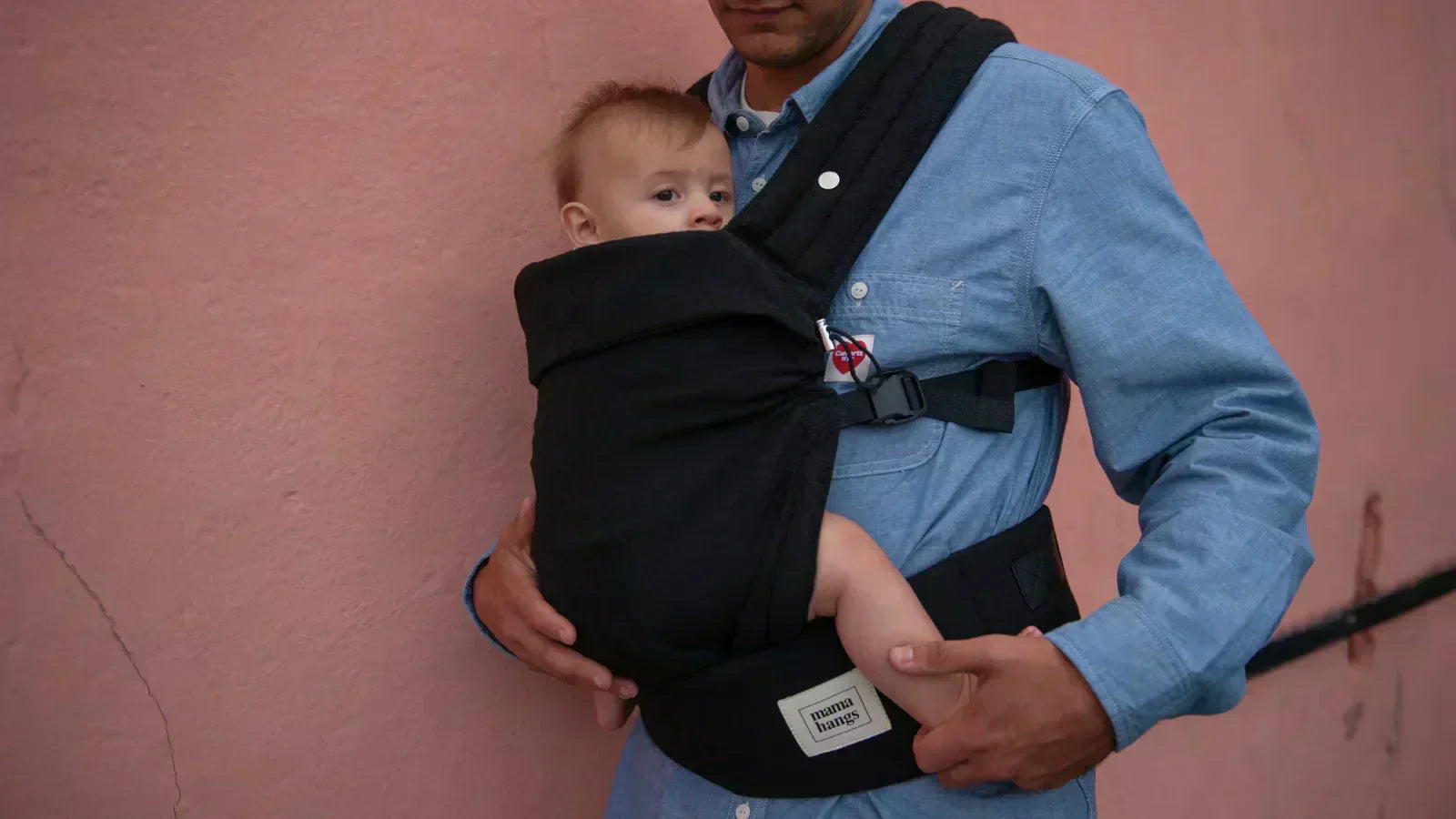
At Mama Hangs, we design baby carriers with parents' comfort in mind... but above all, with babies' well-being and natural development at heart. We work closely with healthcare professionals and babywearing consultants to ensure that every one of our products respects babies' needs and supports parents in carrying their little ones safely.
We regularly receive questions about forward-facing babywearing (when baby faces outwards, towards the world rather than towards the person carrying them). Some brands promote it as a key feature. We have chosen a different approach, and here's why.
What is ergonomic babywearing?
Babywearing is considered ergonomic when it respects a baby's natural position, as seen instinctively in newborns when held against an adult: a gently rounded back, a tilted pelvis, legs bent in an M or "frog" position, knees higher than the bottom, and even support along the back of the thighs up to the knees. This position:
supports the natural development of the spine,
supports healthy hip development and helps reduce the risk of hip dysplasia,
encourages bonding and a sense of security,
supports baby's digestive comfort,
allows baby to rest, breastfeed or fall asleep easily.
This natural carrying position evolves with age: as your child grows, their back muscles become stronger and their posture gradually becomes more upright.
👉 To find out more, we've written a complete guide to ergonomic babywearing, explaining this key position, its benefits and the best practices to follow.
At Mama Hangs, we offer baby carriers designed to support every stage of your baby's development. The Carry & Pack is perfectly suited from birth, offering a snug, ergonomic and secure front carry for little ones up to 18 months. The Carry & Bloom allows front carrying from 3 months, followed by back carrying once baby can sit up independently (usually around 6–8 months). It supports your child up to 20 kg and remains ergonomic up to 4 years old. The Carry & Walk, meanwhile, offers a hip-carry option once baby can sit independently, usually from around 9 months.
What is forward-facing babywearing?
Forward-facing babywearing means positioning your baby against your chest, but facing outwards towards the world. Your baby is therefore looking away from you, with their back resting against your torso.
Some parents are drawn to this position because they feel their baby is curious and wants to see what's going on, or because their little one cries when placed facing them. We understand the desire to let babies explore the world around them. However, this position raises several concerns from a physical, emotional and developmental perspective.
Why we don't recommend forward-facing babywearing
1. A position that doesn't support baby's natural posture
In this position, baby's back is often too straight or even arched, as they cannot naturally curl their spine as they need to. This goes against the natural development of the spine, which gradually develops through successive curves (cervical, thoracic and then lumbar).
What's more, baby's legs often hang straight down, without the necessary support beneath the thighs. This position can create tension around the hips and is not recommended when particular care needs to be taken with hip development. Baby ends up suspended by the crotch, which is neither comfortable nor ergonomic. This can be particularly uncomfortable for baby boys, as it may put significant pressure on their genitals.
2. Insufficient head and neck support
When a baby falls asleep in a carrier, their head becomes heavy and their neck needs stable support. When facing the person carrying them, babies can naturally rest their head against their parent's chest. The parent can also adjust the fabric of the baby carrier to provide additional support.
By contrast, in a forward-facing position, baby's head has no support. When tired or asleep, their head may fall forwards or to the side, potentially compromising the alignment of their airways. This is particularly concerning for young babies who do not yet have good head and neck control. It also makes it harder for parents to keep an eye on their baby's face and ensure that their breathing is unobstructed.
3. Sensory overload
The world is big, noisy and bright. A newborn or young baby has a nervous system that is still developing. When facing outwards, they cannot turn away or snuggle against their parent if they feel stressed or overstimulated. This can lead to tiredness, irritability and even distress.
When facing their parent, on the other hand, babies can explore the world at their own pace, snuggle into the crook of their parent's neck or feel reassured by the familiar sound of their parent's heartbeat and voice.
4. Less effective temperature regulation
When carried facing outwards, babies are no longer nestled against their parent's chest. Yet this closeness plays an important role in helping regulate their body temperature, particularly during the first months of life.
Studies have shown that a mother's breast temperature can automatically adjust to warm a baby who is cold or, even more surprisingly, cool down a baby who is too warm. This natural mechanism, known as thermal synchrony, works most effectively when baby is facing their parent, chest to chest. In a forward-facing position, this valuable physiological benefit is lost.
5. Limited communication
Forward-facing babywearing prevents visual interaction between baby and the person carrying them. It becomes difficult to pick up on signs of tiredness, hunger or discomfort. Likewise, babies can no longer benefit from their parent's facial expressions, which play an important role in the development of attachment and language.
6. Less comfortable for the person carrying the baby
This position shifts baby's weight forwards, away from the parent's centre of gravity. This can put strain on the back, tire the shoulders and make carrying less comfortable, especially as baby gets heavier. This is why occupational therapists and babywearing specialists often advise against it.
👉 For women whose pelvic floor has been weakened by pregnancy or childbirth, this forward shift in weight may also increase pressure and discomfort, and potentially slow down recovery.
What are the alternatives to forward-facing babywearing?
What if your baby wants to look around? That's great news! It means they're growing, becoming curious and discovering the world around them. But that doesn't mean you have to give up ergonomic babywearing!
Here are some alternatives we recommend:
➤ Side carrying from around 3 months (Mama Hangs Sling)
Our slings are perfectly suited to newborns and allow for an ergonomic side carry from around 3 months (once your baby's natural hip opening allows for it). Quick to put on, they offer closeness and good support while respecting your baby's natural posture. A lovely way to vary carrying positions while keeping baby close.

➤ Hip carrying (Carry & Walk)
From 9 months, you can carry your baby on your hip. They get a lovely view of the world around them while remaining close to you. They can turn their head, interact with their surroundings, but also snuggle against you whenever they feel tired or overwhelmed. Hip carrying is an excellent transition between front and back carrying.

➤ Back carrying (Carry & Bloom)
From 6 months, back carrying is a comfortable and practical option. Baby can see over your shoulder, observe whatever catches their interest, while you keep your hands free for everyday activities. It's an ideal solution for curious little ones and active parents!

➤ Exploring without a carrier
You can also give your baby opportunities to explore without being carried: on a play mat on the floor, in your arms facing outwards for a few minutes, or in a sling with a slightly off-centre position. The key is to alternate carrying time with free play, according to your baby's age and needs.
In a nutshell
At Mama Hangs, we believe in ergonomic babywearing that respects your baby's body and the parent-child bond. Although popularised by some brands, forward-facing babywearing does not align with this approach. That's why our carriers are not designed for this position.
With the Carry & Bloom (front and back carrying) and the Carry & Walk (hip carrying), we offer versatile, adaptable solutions that respect your baby's needs, so you can carry them for longer, comfortably... and always with confidence.
Want to find out more?
👉 Explore our range of baby carriers
👉 Get in touch and we'll help you find the carrier that's right for you.