
Our tips for choosing your MAMA HANGS carrier model.
Are you expecting a baby or are you new parents?
Are you interested in physiological babywearing and want to learn more?
Are you wondering which product to choose to carry your baby?
Discover the key elements to help you make your decision.
Why carry my baby?
Babywearing is an ancestral practice that was set aside for a few decades by Western societies in favor of strollers. The return to more natural and baby-centered parenting methods has brought it back into the spotlight.
What are the benefits of keeping your newborn close to you?
Benefits of physiological babywearing for the baby
- It strengthens the emotional bond. Physical closeness releases oxytocin, the attachment hormone.
- It regulates the baby's nervous system. Rhythm, warmth, and familiar scents provide comfort and reassurance.
- The upright position aids digestion.
- It stimulates muscle tone and balance.
- It supports harmonious growth by promoting the physiological development of the hips and spine.
Benefits for parents
- It supports breastfeeding by stimulating lactation and making nursing easier.
- It allows you to respond to your baby's needs quickly and appropriately, boosting your confidence.
- It gives you the freedom to go about your daily activities while taking care of your little one—it's the ultimate "hands-free" parenting tool!

Is babywearing suitable for everyone?
Which babies can be carried?
Newborns can be carried from birth. If your baby was born prematurely, seek advice from a healthcare professional. There is no age limit for carrying a child.
Make sure your baby's weight is within the range recommended for the carrier you have chosen.
Babywearing can be particularly helpful for:
- Babies who tend to feel uncomfortable after feeding
- Little ones who find it difficult to settle themselves
- Children who need a little more time to reach certain developmental milestones
- Babies with more delicate hips.
My baby doesn't enjoy being carried. Is that normal?
Babywearing can benefit all children. If your baby doesn't seem to enjoy it, cries or has difficulty curling up in the sling because they tend to arch their back, it may be worth discussing this with a healthcare professional. A manual therapist (such as an osteopath or chiropractor) can help identify whether tension may be contributing to the discomfort.
Who can carry a baby?
Both mum and dad can carry their baby. Babywearing gives fathers a wonderful opportunity to build a strong bond with their child and support their partner, for example when she is breastfeeding.
Depending on how you are recovering after childbirth (abdominal area, pelvic floor, etc.), ask your midwife or gynaecologist for advice.
Babywearing does not require any particular level of fitness, although you may find that your stamina improves over time!
Another adult can also use a baby carrier with your little one, if you wish (grandparents, nanny or childminder).
However, children should not carry babies.
When can you carry your baby?
Babywearing can be part of everyday life in many different situations:
- As a way of getting around, for example when dropping your child off at nursery or with their childminder.
- For walks on all kinds of terrain, as long as you remain comfortable and at ease while moving.
- For your baby's naps: they can drift off peacefully while you keep your hands free to get on with other things.
- To comfort your child when they are in pain or have a fever.
- Simply for the pleasure of being close!

The safety rules to follow when carrying your baby
Up to 6 months, carry your baby in the front position.
- Always ensure that their nose and mouth are clear.
- Ensure proper physiological positioning (our tutorials are here to guide you):
- Seated/squatting
- Hips in retroversion
- Rounded back
- Head and trunk aligned
- Hands within reach of the mouth
- No footrests
- Adjust the baby’s clothing according to the weather: the carrier acts as a layer of clothing. If it’s sunny, protect your child’s head. You can match our baby hat with your carrier system.
- Do not carry your child while sleeping.
- Carrying is prohibited in a motor vehicle: a car seat is essential for the baby.
- Avoid engaging in sports activities while carrying.
- Do not cook with your baby on you.
Mama Hangs’ physiological carrying systems
ALL OF OUR PRODUCTS OFFER A PHYSIOLOGICAL CARRYING POSITION ON THE FRONT.
-
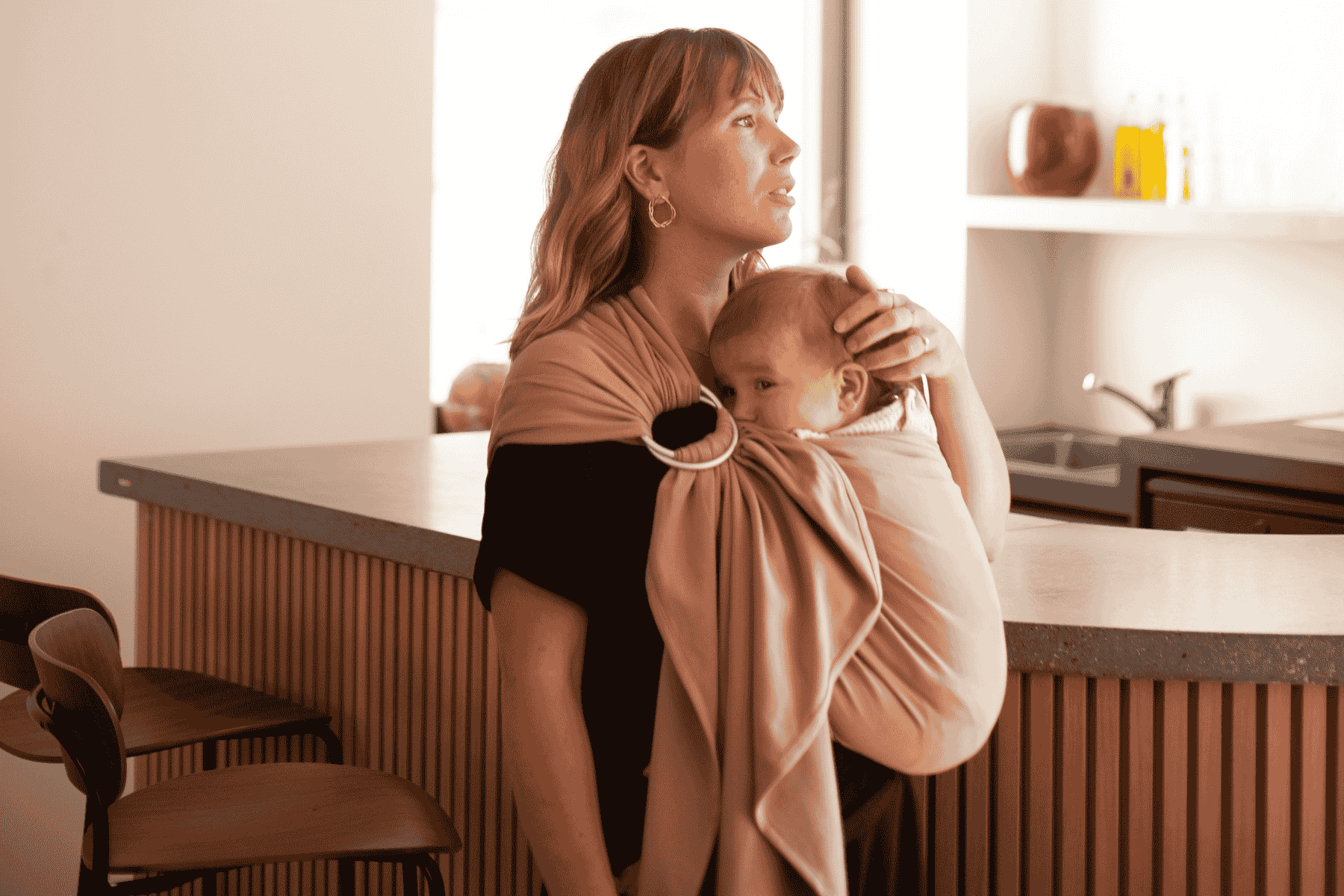
The sling
It’s a baby carrier that doesn’t require knots, thanks to the double ring that allows you to position the device. The carrying is done asymmetrically, over one shoulder. Alternating the position is recommended for your bodily balance.Learn more -
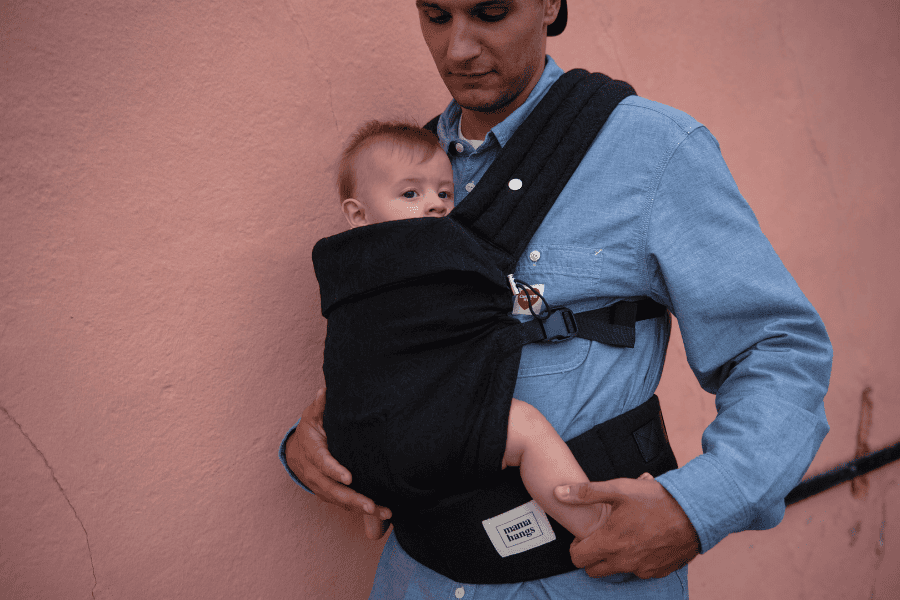
Babywearing Clothing for Women and Men
You practice babywearing and want it to seamlessly integrate into your life?En savoir plus
Our range of babywearing outfits is for you! The babywearing system with adjustable straps is incorporated into our clothing, allowing you to carry your baby from birth. When you set the baby down, the carrying system becomes invisible and transforms into everyday clothing. -

Le Carry & Walk
Learn moreThe perfect quick-carry solution for toddlers from 9 months (7kg) to 4 years (20kg). It helps relieve your arms on short trips when your child no longer wants to walk. Ideal for city strolls, nature outings, or even quick errands, it adapts to all your moments, offering flexibility and freedom.


| Products | CARRY & PACK | Hoodies Fatherhood et Motherhood | Sling | CARRY & BLOOM |
|---|---|---|---|---|
| Price | 125€ | 149€ | 69€ | 269€ |
| Baby's weight | 3.5kg to 10kg | 3.5kg to 10kg | 3.5kg to 10kg | 5kg to 20kg |
| Baby's age | Newborn to 18 months | Newborn to 18 months | Newborn to 2 years | 3 months to 4 years |
| Material | 95% GOTS organic cotton + 5% elastane | Extérieur : 100% Molleton Structure Portage : 95% coton biologique GOTS + 5% élasthanne | 95% GOTS organic cotton + 5% elastane | 100% GOTS organic cotton or Jacquard (cotton + recycled polyester) |
| GOTS certification | Yes | Yes | Yes | Yes |
| Machine washable | Oui à 30° | Oui à 30° | Oui à 30° | No |
| Technical specifications |
|
|
|
|
| Men's Product | ✔ | ✔ | ✔ | ✔ |
| Women's Product | ✔ | ✔ | ✔ | ✔ |
| Carrying position | Front | Front |
|
Front and back |
| Physiological babywearing. | ✔ | ✔ | ✔ | ✔ |
| Worn directly on the skin. | ✔ | ✔ | ✔ | Not recommended but possible. |